

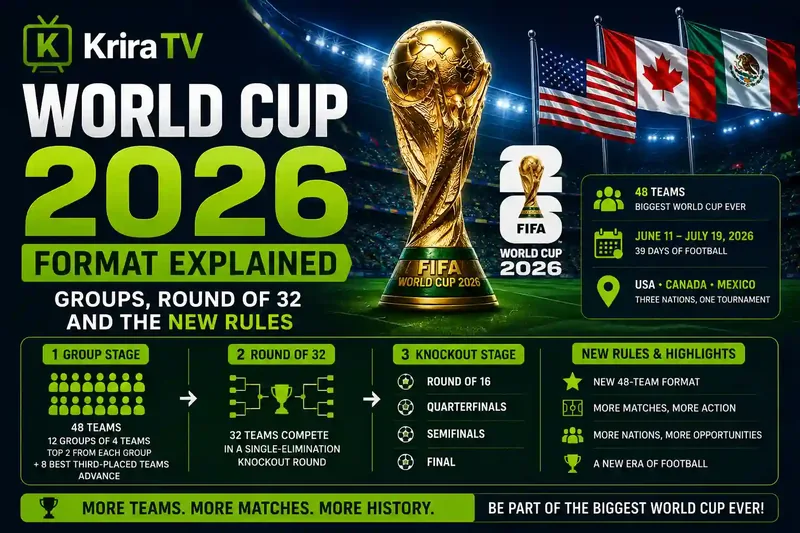
The 2026 FIFA World Cup is over, and the format everyone spent two years arguing about has now been tested in public. Forty-eight teams, twelve groups, 104 matches and a brand-new Round of 32 — it delivered the longest tournament in the competition’s history and, on the evidence of what happened in June and July, one of the most unpredictable.
Spain won it, beating defending champions Argentina 1–0 in extra time at MetLife Stadium on 19 July. But the story of this World Cup was not really the final. It was what the new structure did to everyone else along the way.
How the 2026 format actually worked
The old format — eight groups of four, top two advance, straight into a Round of 16 — ran from 1998 to 2022. With 48 teams, that arithmetic no longer works. Here is what replaced it:
- 12 groups of four teams instead of eight.
- The top two from each group advance — that is 24 teams.
- The eight best third-placed teams also advance — bringing it to 32.
- A new Round of 32 was inserted before the Round of 16.
- 104 matches in total, up from 64 in Qatar 2022.
The knock-on effect is that a team now needs seven wins to lift the trophy rather than the old four-group-games-plus-four-knockouts route. It also means a team can finish third in its group and still go all the way — which changes how sides approach the group stage entirely.
The third-place rule changed everything
This was the most-criticised part of the format before the tournament, and the most interesting during it. Because eight of the twelve third-placed teams qualify, a side could take three draws and still reach the knockouts.
That is more or less exactly what Cabo Verde did — and it produced the story of the group stage. The archipelago nation of just over 500,000 people, ranked 67th in the world and playing at their first World Cup, drew all three of their Group H games, including a 0–0 against eventual champions Spain. Three draws, three points, second place in the group ahead of Uruguay and Saudi Arabia, who both went home on two.
They then took Argentina to 3–2 in the Round of 32 in Miami. Under the old sixteen-team knockout format, Cabo Verde would never have been there at all.
The Round of 32 was carnage
Adding an extra knockout round gave the big teams one more chance to go out early, and several took it. The round produced two results that will be replayed for years:
- Paraguay 1–1 Germany (4–3 on penalties). Julio Enciso headed Paraguay in front just before half-time from a Matías Galarza cross; Kai Havertz equalised for Germany after the break from a Florian Wirtz assist. In the shootout, Paraguay goalkeeper Orlando Gill saved two penalties and watched another fly over the bar. Four-time champions, out in the first knockout round.
- Morocco 1–1 Netherlands (3–2 on penalties). Morocco equalised in the first minute of added time when Diop finished a Chemsdine Talbi cross from close range. Ismael Saibari buried the decisive penalty into the left corner. Morocco went on to beat Canada in the Round of 16.
Two European heavyweights eliminated on penalties on the same day. That is the format working as intended, depending on which country you support.
How the champions got there
Spain’s route was not the smoothest — that 0–0 against Cabo Verde in their opening game set the tone — but they finished top of Group H on seven points and grew into the tournament. They beat France 2–0 in the semi-final.
Argentina, the holders, came through the other side. They edged Cabo Verde 3–2, and in the semi-final scored twice late to beat England 2–1. They were trying to become the first team to retain the World Cup since Brazil in 1962.
The final: Spain 1–0 Argentina
Ninety minutes could not separate them. The goal came in the 106th minute, in the first period of extra time, from Ferran Torres. In front of a crowd of more than 80,000 at MetLife Stadium, it was enough to give Spain their second World Cup, sixteen years after their first in 2010.
Argentina goalkeeper Emiliano Martínez made 11 saves — a record for a World Cup final. He kept Argentina in the match almost single-handedly and still finished on the losing side.
The individual awards
| Award | Winner | Notes |
|---|---|---|
| Golden Ball | Rodri (Spain) | Best player of the tournament |
| Silver Ball | Lionel Messi (Argentina) | |
| Bronze Ball | Kylian Mbappé (France) | |
| Golden Boot | Kylian Mbappé (France) | 10 goals — first man to win it twice |
| Silver Boot | Lionel Messi (Argentina) | |
| Bronze Boot | Jude Bellingham (England) | |
| Golden Glove | Unai Simón (Spain) | |
| Young Player | Pau Cubarsí (Spain) |
Mbappé’s second Golden Boot, after Qatar 2022, makes him the only man to have won the award twice — and he did it for a France side that went out in the semi-finals.
So did the 48-team format work?
The two fears going in were that the group stage would be padded with dead rubbers, and that adding teams would dilute the quality. What actually happened was closer to the opposite. The third-place qualification route meant almost every group stayed alive into the final round of matches, and the extra knockout round removed two of the pre-tournament favourites before the quarter-finals.
The fair criticism is length. 104 matches across 39 days is a lot of football, and the group stage did feel slow in places. But the format gave debutants like Cabo Verde a genuine route into the knockouts, and it gave us Paraguay knocking out Germany. On balance, it delivered.
Watching the next tournament
The World Cup is done, but the football calendar is not — domestic leagues, continental competitions and international windows run all year. Krira TV carries live football alongside cricket, with multiple server links per match so a slow stream can be swapped rather than abandoned. It is a free Android app; you can download the latest APK here, or read the step-by-step installation guide if this is your first time installing an APK.